
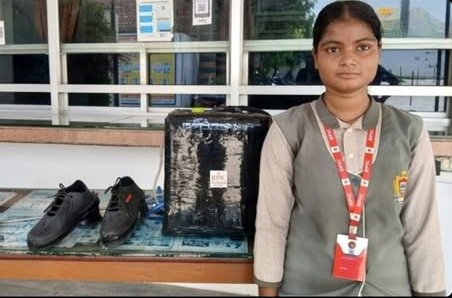
Ranjoo Maddheshiya, a student from Maharajganj, Uttar Pradesh, has developed Kisan Vardan 0.2, a low-cost pesticide sprayer powered by farmers’ footsteps.
In a country where millions of families depend on farming, even a small innovation can make a big difference. From Maharajganj district in Uttar Pradesh comes an inspiring student story that proves young minds can solve real problems when curiosity meets purpose. Ranjoo Maddheshiya, a student of RPIC School at Bijapar in the Siswa Bazar area of Maharajganj, has developed a unique pesticide sprayer for farmers. She has named it “Kisan Vardan 0.2”, meaning a blessing for farmers. What makes her innovation special is its simple but powerful idea. The sprayer does not need electricity, battery power or repeated manual pumping. Instead, it works with the energy generated when a farmer walks in the field.
A Student Innovation Rooted in Rural Reality
Farmers often need to spray pesticides or fertilisers across their fields. Many commonly used sprayers depend on electricity, battery charging or manual pumping. For small and marginal farmers, these machines can add cost, effort and maintenance challenges. Ranjoo looked at this everyday difficulty and asked a practical question: Can a sprayer work while the farmer simply walks?
Her answer became “Kisan Vardan 0.2”.
The device is connected with specially designed shoes. When the farmer wears these shoes and walks, the movement creates compressed air. This air moves through a pipe into the sprayer tank and helps push the pesticide or fertiliser out through the nozzle. In simple terms, every step taken by the farmer becomes useful energy.
How the Footstep-Powered Sprayer Works
According to Ranjoo, the special shoes have an air bladder fitted inside them. When pressure is applied while walking, the bladder generates compressed air. This air is sent through a pipe to the sprayer tank. As the farmer keeps walking in the field, the system continues to support spraying. The farmer does not need to repeatedly pump by hand. There is also no need for external electricity or battery support. This makes the machine environment-friendly, low-cost and easier to use.
From a classroom idea to a farmer-friendly machine, Ranjoo’s innovation walks with purpose.
Built with School Support and Team Spirit
Ranjoo developed the sprayer with support from her school administration. Her friend Nibha Yadav also helped her during the making of the model. The project was not created overnight in thought. Ranjoo says she had been preparing and thinking about the idea for nearly a year. Once the concept was clear, she built the working model in about two days. Her journey shows how student innovation grows through observation, patience and guidance. It also highlights the role schools can play in encouraging practical problem-solving among students.
| Student Detail | Information |
|---|---|
| Name | Ranjoo Maddheshiya |
| School | RPIC School |
| Location | Bijapar, Siswa Bazar, Maharajganj, Uttar Pradesh |
| Innovation | Footstep-powered pesticide sprayer |
| Project Name | Kisan Vardan 0.2 |
| Purpose | To help farmers spray pesticides and fertilisers with less effort |
| Key Feature | Works without electricity, battery or manual pumping |
| Support | School administration and friend Nibha Yadav |
| Estimated Cost | Rs. 1,500–1,600 prototype; Rs. 500–700 in bulk production |
A Low-Cost Solution for Farmers
The prototype of the pesticide sprayer cost around Rs. 1,500 to Rs. 1,600 to build. Ranjoo believes that if the sprayer is produced in bulk, the cost could come down to around Rs. 500 to Rs. 700. That price range could make it useful for small farmers who need affordable and simple farm tools. The machine has also been designed to be lighter than many regular sprayers. This can help farmers carry it more comfortably while working in the field.
Why Ranjoo’s Idea Matters
Ranjoo’s innovation is important because it comes from understanding a real-life problem. She did not create a machine only for a school project. She thought about farmers, their labour, their expenses and their daily challenges. Her invention reminds us that innovation does not always need expensive laboratories. Sometimes, a useful idea can come from a classroom, a village, a farm and a student who asks the right question. In India, where agriculture remains central to rural life, such student-led solutions can inspire a new generation of young innovators. They can help build technologies that are affordable, local and practical.
A Young India Inspiration
Ranjoo Maddheshiya’s story is a strong example of how young Indians are using science for social good. Her “Kisan Vardan 0.2” is more than a pesticide sprayer. It is a message that students can become problem-solvers for the nation. From Maharajganj to the larger world of innovation, Ranjoo’s journey proves that age is no barrier to impact. With the right support, encouragement and mentorship, India’s school students can create solutions that make life easier for farmers, workers and communities. Her idea turns a farmer’s footsteps into energy. More importantly, it turns a student’s imagination into hope.